By Julian Sterling, Lead Investigative Correspondent
January 19, 2026
In the mid-1990s, the world was gripped by a specific, plush kind of hysteria. We were told that a six-foot-tall Tyrannosaurus rex with a voice like a congested hug was the pinnacle of educational entertainment. But as we look back from the vantage point of 2026—an era where we have finally admitted that clowns are inherently sinister—it is time to address the purple elephant in the room.
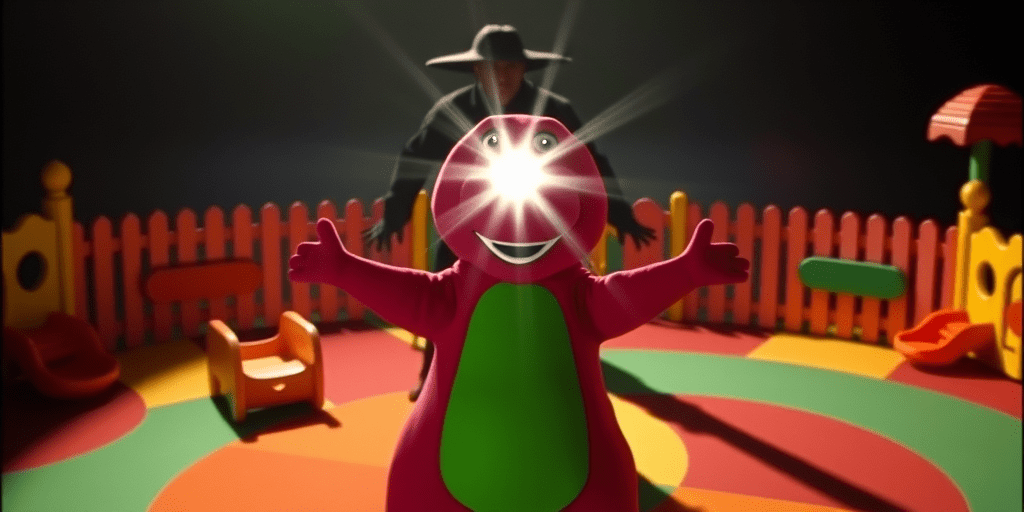
Barney & Friends wasn’t just a children’s show; it was a surrealist fever dream that flirted with the uncanny valley long before we had a name for it. While the show preached “I Love You,” the subtext often whispered something much more unsettling. Here, we deconstruct the ten moments that proved Barney was secretly a cosmic horror masquerading in polyester.
1. The Metamorphosis (Every Single Episode)
The show always began with a stuffed doll sitting on a shelf. Through the sheer, terrifying force of “imagination,” this inanimate object would swell into a sentient, bipedal carnivore. There is no biological or magical precedent for this that doesn’t involve a blood sacrifice. Watching the doll expand like a slow-motion explosion of purple fur remains the primary source of millennial night terrors.
2. The “I Love You” Compulsion
The theme song isn’t an invitation; it’s a mandate. “I love you / You love me / We’re a happy family.” The lyrical structure implies a closed loop from which there is no escape. In the 1994 episode “Barney’s Birthday,” the kids chant this with a rhythmic intensity that suggests they aren’t singing for fun—they’re singing for survival.
3. The Arrival of Baby Bop
When Baby Bop first appeared, carrying a security blanket that seemed to have its own gravitational pull, the power dynamics of the playground shifted. Her high-pitched giggles often felt like they were coming from inside your own skull. There was a moment in Season 3 where she stared directly into the camera for five seconds too long, silently daring the viewer to question her existence.
4. The Infinite Schoolyard
The “playground” set was a liminal space par excellence. There were no fences, no neighbors, and the sky was a flat, unyielding shade of cerulean that never saw a cloud. It was a pocket dimension where time stood still, and the only escape was to learn a lesson about sharing.
5. The “Imagination” Logic
In “Imagine with Barney,” the dinosaur explains that you can make anything happen just by thinking about it. This is essentially the plot of The Twilight Zone’s “It’s a Good Life.” A creature with the power to rewrite reality at will, who also insists on constant physical affection, is a high-level threat in any century.
6. The Eyes
If you look closely at the 1990s Barney suit, the eyes are fixed in a permanent, dilated stare. They don’t track movement. They don’t blink. They simply absorb the light of the studio, reflecting nothing back but the hollow joy of a prehistoric predator who has traded hunting for singing.
7. The Wink
In several early episodes, Barney would end a segment by winking at the audience. Due to the limitations of the costume, this often looked like a localized facial collapse. It was a reminder that behind the mask was a human being, sweating and struggling to breathe, trapped in a purple tomb.
8. The Unexplained Knowledge
How did Barney know everyone’s name? How did he know where the kids lived? In “Barney Goes to School,” he arrives before the janitor. He is omnipresent. He is the surveillance state, but with a better singing voice.
9. The Barney “Bop”
The way Barney moved—a rhythmic, side-to-side swaying—was designed to be soothing. However, when viewed in the context of 2026’s “Slow-Burn Horror” aesthetic, it looks more like the ritualistic swaying of an entity preparing to unhinge its jaw.
10. The Final Goodbye
At the end of every episode, Barney would revert to his doll form. The children would leave, the lights would dim, and the camera would linger on the lifeless plush. The implication was clear: the monster is still in the room. He’s just waiting for you to imagine him again.
 Real.Good.News.
Leave a comment