By Avery Finch, Senior Culture & Lifestyle Editor
January 19, 2026
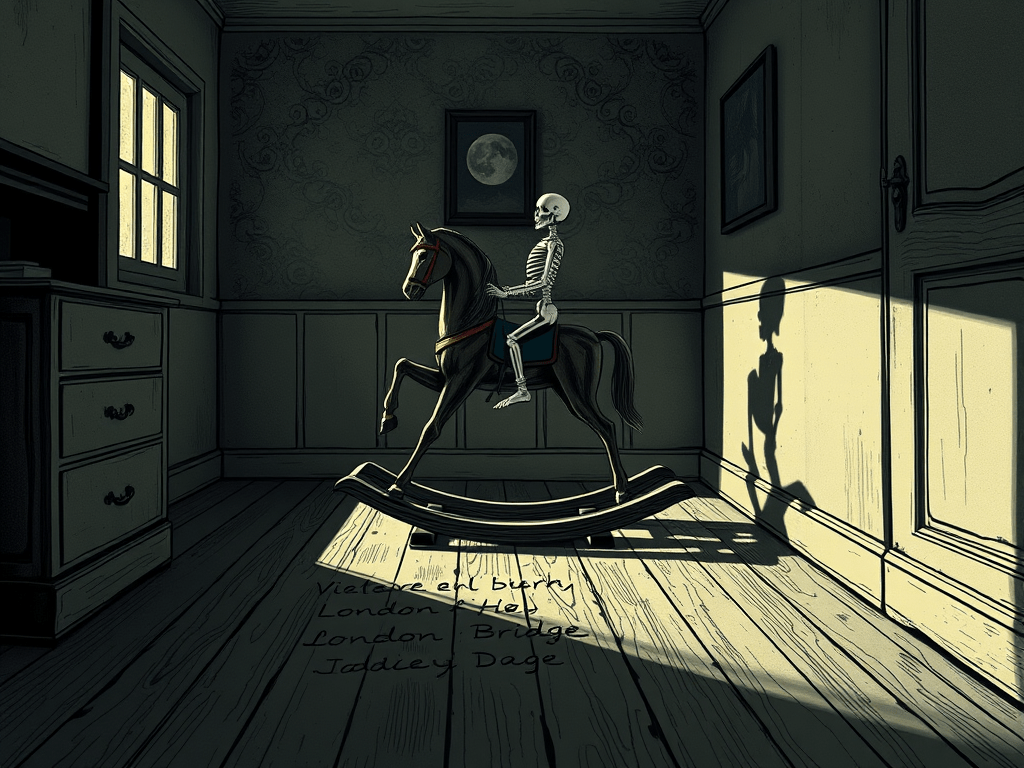
As we navigate the “Retro-Reset” of 2026, parents are increasingly returning to the acoustic simplicity of nursery rhymes to escape the “algorithmic hum” of modern toys. But as we hum these tunes to our toddlers, we are often reciting oral histories of plague, execution, and religious persecution. These melodies were never meant to be “cute”; they were the 17th-century equivalent of a front-page tragedy.
Before you start another sing-along, here are the grim realities behind eight childhood staples.
1. Ring Around the Rosie
The gold standard of morbid folklore, this rhyme is widely believed to be a play-by-play of the Great Plague of London in 1665. The “rosie” was the red rash of the infection; the “posies” were herbs carried to mask the scent of decay. “Ashes, ashes” refers to the cremation of the bodies, and “we all fall down” was the final, lethal conclusion. In 2026, it remains the ultimate “playground memento mori.”
2. Mary, Mary, Quite Contrary
While it sounds like a song about gardening, many historians point to “Bloody” Mary I of England. The “garden” is a graveyard, the “silver bells” were a nickname for thumb-screws, and “cockle shells” were instruments of torture applied to the genitals. It is a song about a queen’s brutal attempt to reverse the Reformation, disguised as a horticultural hobby.
3. London Bridge is Falling Down
The dark theory behind this one involves “immurement”—the ancient practice of entombing a living person into the foundations of a structure to ensure its stability. The “fair lady” mentioned in the song wasn’t a guest; she was the sacrifice. While the bridge has been rebuilt many times, the song serves as a ghostly reminder of the high cost of Victorian infrastructure.
4. Rock-a-Bye Baby
Number four will truly shock you, as it describes a literal child-safety nightmare. One popular origin story suggests the song refers to a 17th-century custom where mothers placed their infants in hollowed-out birch bark cradles suspended from tree branches. If the wind blew too hard, the “cradle would rock,” and the child would fall from a height that was almost certainly fatal. It is a lullaby about gravity-induced tragedy.
5. Three Blind Mice
This upbeat tune is actually a coded tale of religious execution. The “three blind mice” are believed to be three Protestant bishops—Cranmer, Latimer, and Ridley—who were blinded and then burned at the stake by Queen Mary I (the “farmer’s wife”). The “carving knife” represents the swift, clinical nature of 16th-century state-sanctioned violence.
6. Baa Baa Black Sheep
This rhyme is a protest song about the Great Custom on Wool of 1275. In medieval England, the king took one-third of the profit (the “master”), the church took one-third (the “dame”), and the shepherd was left with a single bag for the “little boy who lives down the lane.” It’s a 750-year-old complaint about a 66% tax rate, surviving into 2026 as a toddler’s favorite.
7. Jack and Jill
While they “went up the hill,” the historical Jack and Jill may have been King Louis XVI and Marie Antoinette. “Jack” lost his crown (and his head) to the guillotine during the French Revolution, and “Jill” followed shortly after. The “vinegar and brown paper” was the contemporary medical treatment for a head injury, though it notably failed to cure a decapitation.
8. Peter Peter Pumpkin Eater
This is a chilling tale of infidelity and domestic imprisonment. According to the lore, Peter’s wife was unfaithful, so he “put her in a pumpkin shell”—a metaphor for a small, windowless stone cell—where he “kept her very well.” In 2026, we’d call this a true-crime documentary, but in the 18th century, they turned it into a jaunty tune about squash.
 Real.Good.News.
Leave a comment