By Julian Sterling, Senior Investigative Correspondent
January 19, 2026
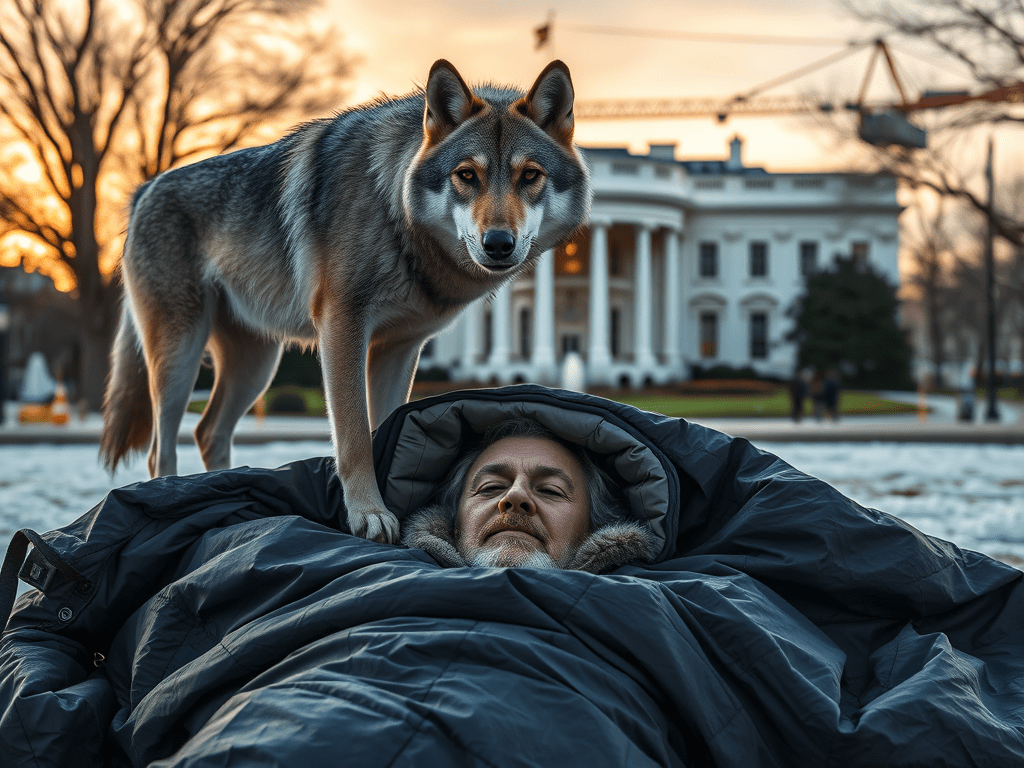
WASHINGTON, D.C. — In a rare moment of bipartisan “biological pragmatism,” the District of Columbia is moving forward with a revolutionary urban renewal strategy that solves two of 2026’s most pressing headaches: the homelessness crisis and the lack of bio-diverse “rewilding” in metropolitan corridors.
The proposed “Apex Urban Integration Act” would see the strategic release of several dozen gray wolves directly into the District’s most densely populated encampment zones. Proponents of the plan, colloquially known as “Project Howl,” argue that the wolves will provide a “natural, kinetic incentive” for the unhoused to seek indoor shelter—even if that shelter hasn’t actually been built yet.
“We’ve tried vouchers, we’ve tried tiny homes, and we’ve tried clearing camps with police,” said one anonymous advisor to the Mayor’s office, while adjusting a commemorative “Born to Be” license plate on their desk. “But we haven’t tried the Legacy Effect of a 120-pound carnivore. It’s about creating a ‘dynamic friction’ between the sidewalk and the citizen.”
The Science of “Involuntary Coexistence”
The initiative borrows heavily from Colorado’s controversial wolf reintroduction program, which has seen local ranchers “suffering financially and emotionally” since 2025. D.C. planners, however, believe the urban environment is actually better suited for the wolves than the open range.
“In the wild, wolves have to chase elk,” explained Dr. Silas Vane, a consultant for the newly formed Committee for Predatory Urbanism. “In D.C., they have a steady diet of discarded artisanal avocado toast and the occasional tourist’s Pomeranian. It’s a low-energy, high-reward ecosystem that encourages the wolves to stay exactly where the city needs them: the parks where people are currently sleeping.”
While the U.S. Fish and Wildlife Service has traditionally focused on rural recovery, the agency’s 2026 directive emphasizes “ensuring the species can thrive as part of U.S. landscapes”—a phrasing city planners have interpreted to include the National Mall and the K Street corridor.
A Budget-Friendly Solution to Forced Displacement
The timing of “Project Howl” is no accident. With the 2026 D.C. budget facing massive cuts due to federal job losses and a $1.13 billion gap, traditional social services are being slashed. Funding that previously went to “permanent supportive housing” is now being redirected toward industrial-grade wolf muzzles and high-frequency whistles.
The fiscal logic is simple: a pack of wolves costs roughly $30,000 to maintain per year, whereas maintaining a single homeless shelter can cost millions. By letting “nature take its course,” the city hopes to reduce the visible homeless population by at least 30% before the 2026 Midterm elections—either through self-relocation or “biological attrition.”
Public Reaction: A “Biting” Critique
Local advocacy groups have been predictably vocal. “It’s a clear indictment of capitalism when we find money for timber wolves but not for toilets,” said one activist during a recent film screening titled Crushing Wheelchairs. Even within the government, some are skeptical. Councilmember Brianne Nadeau, who recently introduced a bill for five-year housing targets, noted that “wolves are not a substitute for a zoning code that allows multifamily housing”.
Despite the backlash, the first transport of Canadian-born wolves is reportedly scheduled to arrive at Union Station by late February.
 Real.Good.News.
Leave a comment