By Julian Sterling | Staff Writer
January 17, 2026
In a nondescript warehouse outside of Des Moines, Iowa, a “delivery truck” is being unloaded under the cover of a freezing January fog. To a casual observer, it looks like a standard shipment of high-end corn harvesters. But inside the reinforced crates lies something far more valuable in 2026: Unsanctioned Compute.
Since the Strategic Compute Reserve (SCR) act went into full effect earlier this month, the Midwest has become the primary corridor for “silicon running.” With the federal government seizing high-end GPUs to power its massive national security simulations, the private ownership of anything more powerful than a calculator has moved into the shadows.
The “Compute Prohibition” Era
The Department of Commerce officially reclassified advanced graphics cards as “Dual-Use Strategic Assets” in late 2025. This means that if your PC has enough “Teraflops” to render a high-fidelity video game, the government believes it also has enough power to crack federal encryption or simulate a small-scale weather event.
“They aren’t just taking the chips; they’re taking the potential,” says ‘Volt,’ an anonymous smuggler who specializes in transporting black-market cards from Canadian ports down through the I-35 corridor. “A single crate of 2025-spec chips can buy you a three-bedroom house in the suburbs right now. People are desperate to keep their local AI models running without a federal backdoor.”
The “Corn-Flop” Network
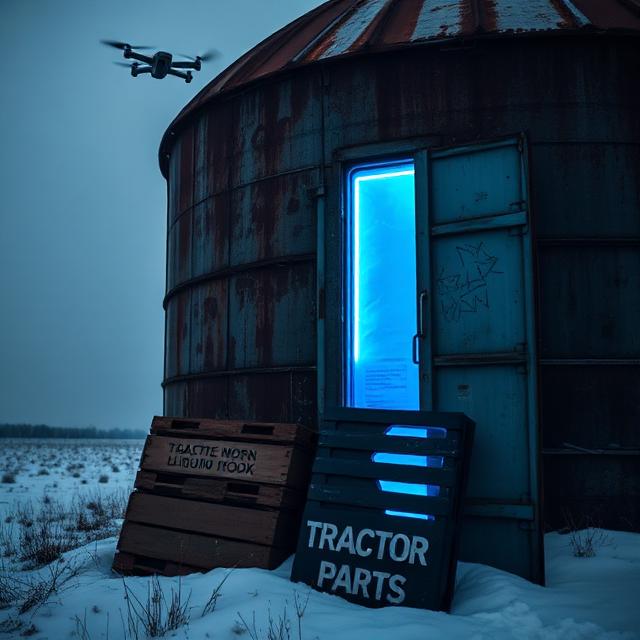
Why the Midwest? The answer lies in the infrastructure. Huge, decommissioned grain silos are being converted into “dark data centers.” These silos provide natural insulation and thick concrete walls that shield the massive heat signatures of illegal mining and AI training rigs from government thermal-imaging drones.
The Electronic Frontier Foundation (EFF) has noted a surge in “Compute Squatting,” where rural cooperatives are pooling their legal electricity allotments to run underground clusters. To the local power grid, it looks like a particularly energy-intensive dairy farm. In reality, it’s a high-speed node for the “Free Net.”
Federal Enforcement: The “Chip-Sniffers”
The response from the FBI’s Cyber Division has been aggressive. “Task Force: Silicon Valley” (ironically based in D.C.) has begun deploying “sniffer” drones that can detect the specific electromagnetic frequency emitted by high-performance cooling fans.
On January 12, 2026, federal agents raided a “gaming lounge” in Omaha, only to find it was a front for a massive deep-fake farm. “We’re seeing a level of sophistication usually reserved for international cartels,” a spokesperson for the NIST AI Resource Center remarked. “These groups aren’t just playing games; they are maintaining an independent digital reality.”
Julian Sterling’s Guide to the Underground
- Watch the Power Bill: If your “hobbyist” rig is drawing more power than a small stadium, the feds will be at your door before your first render finishes.
- Thermal Masking: Underground operators are reportedly using liquid-nitrogen cooling loops vented into local sewers to hide their heat spikes.
- Know the Exchange: In 2026, the most stable currency isn’t the Dollar or Bitcoin; it’s “Compute Credits” on an unmonitored local network.
As the government tightens its grip on the silicon supply chain, the Midwest remains the front line of the digital resistance. In 2026, the most dangerous thing you can own isn’t a weapon—it’s a graphics card.
 Real.Good.News.
Leave a comment