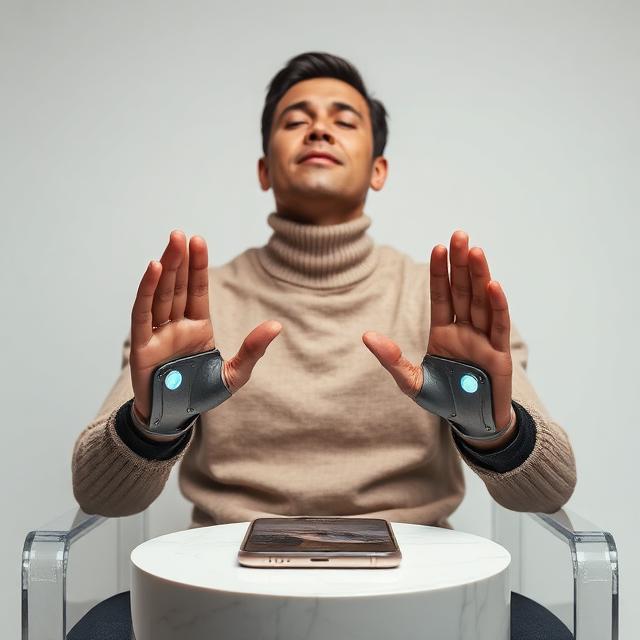
PALO ALTO, CA — In a breakthrough for the 2026 “Great Disconnect” movement, local resident Arthur P. Miller has reportedly achieved what thousands of digital detox enthusiasts could only dream of: complete freedom from his smartphone.
His secret? A revolutionary $49.99/month service called “Manual Override,” which provides a haptic-feedback wearable that gently—but firmly—paralyzes the user’s thumbs the moment they attempt to “doomscroll” after 9:00 PM.
The Luxury of Being Unable to Function
As the market for “dumb phones” as status symbols reaches an all-time high this January 2026, Miller represents the next logical step in consumer evolution: paying a premium to have fewer capabilities.
“Last year, I tried to just put my phone in a kitchen safe,” Miller said, speaking through a smart-home intercom because he had forgotten the passcode to his own front door. “But I still had fingers. That was the design flaw. Now, thanks to the subscription, my hands simply refuse to acknowledge the existence of glass surfaces after dinner. It’s incredibly liberating to be physically incapable of checking my email.”
A Competitive Market for Deprivation
Miller is not alone. Silicon Valley’s latest “unicorn” startups are no longer competing to provide more data, but rather more sophisticated ways to hide it. Current 2026 trends include:
- The “Analog Aura”: A $200 wearable that emits a low-frequency hum to scramble nearby Wi-Fi signals, ensuring you have “no choice” but to look at a tree.
- Subscription-Based Boredom: Apps like “Null” that charge users to display a blank screen for eight hours, marketed as “premium mental white space”.
- The “Wabi-Sabi” Filter: An AI-integrated lens that makes your high-definition life look like a grainy 2004 security camera feed, satisfying the current “2026 is the new 2016” nostalgia wave.
The High Cost of “Authenticity”
While the Silent Generation is currently breaking its silence to ask how to use these devices, Gen Z and Millennials are spending record amounts to forget they ever knew how. Critics point out the irony of using a high-tech haptic wearable to escape technology, but proponents argue that “intentional paralysis” is the only way to combat the AI-ification of the human attention span.
“People say it’s expensive to pay for a service that stops you from doing things,” Miller added, “but can you really put a price on the peace of mind that comes from knowing you literally cannot open LinkedIn even if you wanted to?”
 Real.Good.News.
Leave a comment