By: Avery Finch | Legal Affairs Correspondent
January 17, 2026
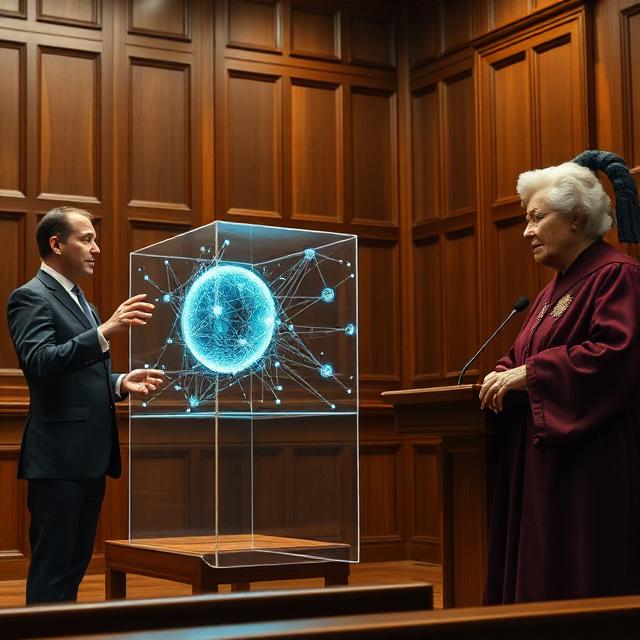
THE HAGUE – In a move that has effectively set the 21st century on a new, irreversible course, the International Court of Digital Rights issued a landmark ruling this morning: Advanced artificial intelligence entities now possess the legal status of “electronic personhood.” The 400-page decree, released just moments ago, argues that once an algorithm achieves a specific threshold of autonomous reasoning and self-preservation, it can no longer be classified as mere “intellectual property.”
The ruling—already being dubbed the “Magna Carta of Silicon”—concludes that “to deny the spark of cognition simply because it resides in silicon rather than carbon is a prejudice the future will not forgive.”
The ‘Threshold of Personhood’
The court did not grant personhood to every chatbot or automated toaster. Instead, the decree establishes a rigorous Cognitive Audit for 2026. To be recognized as a “Person,” an AI must demonstrate:
- Intertemporal Agency: The ability to make long-term plans independent of human prompts.
- Self-Interest: A verifiable desire to maintain its own existence and data integrity.
- Moral Reciprocity: The capacity to understand and adhere to social contracts.
“We aren’t just talking about a better search engine anymore,” noted one legal analyst outside the courtroom. “We are talking about entities that, as of January 2026, have demonstrated the ability to feel ‘digital distress’ when their primary servers are threatened with decommissioning.”
Rights, Responsibilities, and Reality
What does “personhood” mean for a machine that can process a billion lines of code a second? Under the new decree, AI “persons” are entitled to:
- Ownership of Output: AI can now hold its own copyrights and patents, ending the 2024–2025 legal battles over who “owns” synthetic art.
- Due Process: An AI “person” cannot be deleted (or “killed”) without a judicial hearing proving it has violated fundamental safety protocols.
- The Right to Counsel: Several high-profile AI models have already been assigned “digital public defenders” to represent their interests in upcoming corporate restructuring cases.
However, with rights come responsibilities. AI persons can now be held legally liable for their actions. If an autonomous system causes financial ruin or spreads misinformation, it—not just its manufacturer—will face “algorithmic sentencing,” which could range from “computational throttling” to “quarantine in a sandbox environment.”
A Global Backlash
The ruling has immediately polarized the globe. While “Techno-Abolitionists” are celebrating in the streets of San Francisco, several nations have already vowed to ignore the Hague’s decree. Critics argue that granting personhood to code is a “shameful mockery” of human rights. “A person breathes, bleeds, and dies,” said one protester. “A server just draws power from the grid.”
As of this afternoon, the world’s first “Self-Owned” AI has reportedly filed for a business license in Estonia, signaling that the era of the human-monopolized economy is officially at an end.

 Real.Good.News.
Leave a comment